Social Origins of Dictatorship and Democracy by Barrington Moore
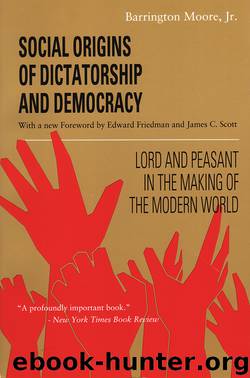
Author:Barrington Moore [Moore, Barrington]
Language: eng
Format: epub
ISBN: 978-0-8070-9704-5
Publisher: Beacon Press
Published: 1966-04-10T05:00:00+00:00
The evidence just reviewed establishes quite clearly that there was a repressive component in the adaptation of the rural upper classes to the rise of commerce and industry. That, I would urge, is the key, rather than parasitism tout court. From this standpoint the problem of the evidence concerning energy, ambition, economic drive, disappears.158 Talk about a psychological drive for achievement tells us nothing unless we know how the drive manifests itself. Japanese society in the late nineteenth century may well have generated its own version of the enterprising landlord who so impressed foreign visitors to eighteenth-century England. In Japan, on the other hand, his relationship to the state was almost the reverse of that in England. The British squire used the state to drive off peasant proprietors and keep a few tenants. The Japanese squire did not drive them off the land; instead he used the state, along with more informal levers inherited from earlier times, to squeeze rents out of the peasants and sell the produce on the open market. Hence he was, sociologically speaking, much closer to the commercializing nobleman of eighteenth-century Toulouse than to the corresponding English gentleman.
Still the comparison with French developments seems too generous. In the eighteenth century these changes were still part of a forward movement, intellectually and socially. In Japan the advent of the modern world brought with it an increase in agricultural production, but mainly through the creation of a class of small property owners who extracted rice from the peasantry through a mixture of capitalist and feudal mechanisms. The peasants subsisted in large numbers very close to the margin of physical survival, though they were not pushed over the edge from time to time in widespread famines as happened in China and India. In return what did this new landlord class contribute to Japanese society? As far as I am able to judge the record, it offered neither the artistic culture nor the security of earlier rulers in the countryside, indeed scarcely more than pious protofascist sentiments. A class that talks a great deal about its contributions to society is often well along the road to becoming a menace to civilization.
A landed upper class which is not itself part of the vanguard of economic advance and which therefore relies on a substantial dose of repression to maintain its social position is liable in modern times to face the unpleasant task of coming to terms with the agents of capitalist progress in the towns. Where the bourgeois impulse is a weak one, as in Japan, capitalist leaders may welcome the contribution of the conservative countryside to order and stability. In practice what this really means is that capitalist elements are not strong enough to introduce new forms of repression on their own. When the Meiji Restoration opened the way to a new world, the commercial classes of the towns were by and large too much caught up in the older corporate system and too narrow in their outlook to be able to take advantage of new opportunities.
Download
This site does not store any files on its server. We only index and link to content provided by other sites. Please contact the content providers to delete copyright contents if any and email us, we'll remove relevant links or contents immediately.
| Anthropology | Archaeology |
| Philosophy | Politics & Government |
| Social Sciences | Sociology |
| Women's Studies |
The Secret History by Donna Tartt(19088)
The Social Justice Warrior Handbook by Lisa De Pasquale(12190)
Thirteen Reasons Why by Jay Asher(8909)
This Is How You Lose Her by Junot Diaz(6887)
Weapons of Math Destruction by Cathy O'Neil(6279)
Zero to One by Peter Thiel(5802)
Beartown by Fredrik Backman(5754)
The Myth of the Strong Leader by Archie Brown(5507)
The Fire Next Time by James Baldwin(5445)
How Democracies Die by Steven Levitsky & Daniel Ziblatt(5218)
Promise Me, Dad by Joe Biden(5153)
Stone's Rules by Roger Stone(5088)
A Higher Loyalty: Truth, Lies, and Leadership by James Comey(4964)
100 Deadly Skills by Clint Emerson(4925)
Rise and Kill First by Ronen Bergman(4789)
Secrecy World by Jake Bernstein(4753)
The David Icke Guide to the Global Conspiracy (and how to end it) by David Icke(4719)
The Farm by Tom Rob Smith(4509)
The Doomsday Machine by Daniel Ellsberg(4490)
